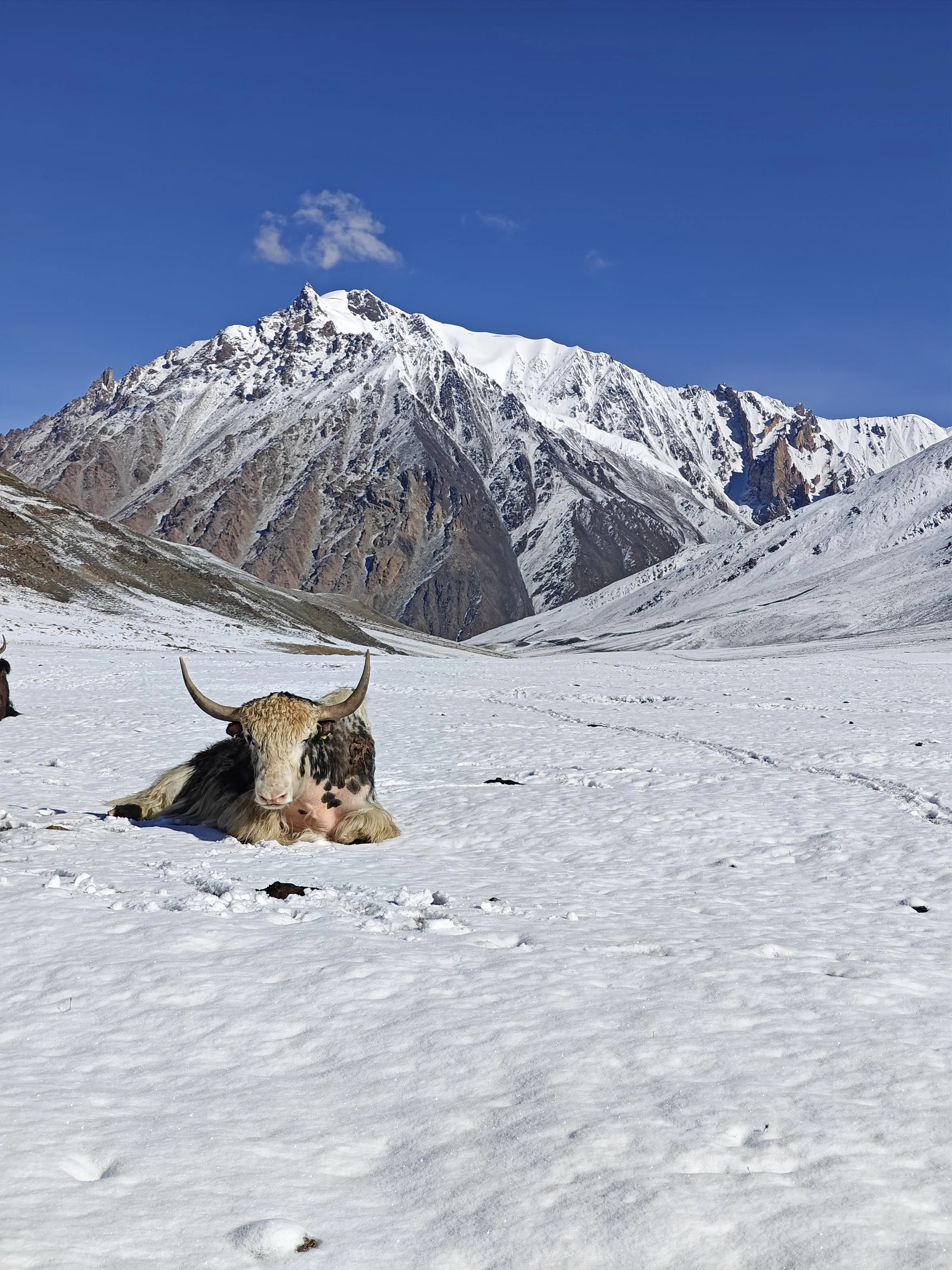
Pakistan (2025)
After days of climbing narrow trails etched into sheer cliffs, above the deep valleys of the Karakoram mountains, Shimshal Pass finally opens before us. Pain and fatigue slowly fade away, replaced by a quiet calm as my dear friend Sahib Jan recites a few lines from his friends’ poem. An ode to their homeland, ancestors, and the memories that continue to draw people back onto these incredibly beautiful paths.
Unforgivable Journey
The journey to the Shimshal Pass in Northern Pakistan places constant demands on both body and mind. For generations, Shimshali families have been walking through these mountains, guiding their animals along extreme narrow trails and crossing active landslides in unpredictable conditions. The route is exhausting, and on this unforgiving terrain local knowledge has always been essential. As the path climbs toward 5,000 meters, the intense sun of the day, with almost no trees for shade, gives way to shivering nights close to zero.
Along the journey there is no electricity, gas, or heating, only a few improvised shelters hidden along the route. Walking this trail today offers only a small glimpse of what the kuch meant for the Shimshali who travel it year after year. Moving between the village and the high pastures that sustained their way of life.
The Meaning of Kuch
Often celebrated as the ‘Valley of Mountaineers’, Shimshal is far more than a remote adventure destination. For the Wakhi families who call it home, it is the land of survival and connection, shaped by generations of seasonal migration, high in the pastures of the Pamir.
For centuries, Shimshali families began the kuch, Wakhi for ‘departure’, in late spring. Whole households moved, along with yaks, goats, and sheep, toward the high pastures of the Pamir. There, they spent their summers working the land, grazing animals on fertile grasses, and preparing their village with stock for the harsh winter ahead. These months of transhumance were essential. Without them, survival down in the secluded village of Shimshal would have been impossible.
Success and Sacrifice
With their herds feeding on wild herbs in an environment free from pollution and guided by generations of traditional knowledge, Shimshal developed a remarkable reputation. Within the high-altitude economy, they sold their butter, cheese, and meat, and over generations the village became known for the exceptional quality of its products. Through the continuous, tough seasonal migration, many Shimshali gained global recognition in the past decades as elite high-altitude mountaineers. “It seems written into our DNA”, one said.
Their road to success was never without danger. The sacrifices tied to the Shimshal Pass are remembered across generations. Along the trail, families lost livestock, endured injuries, and even mourned their relatives who never got to return from the journey. These risks were written into everyday life in the high mountains. Despite the hardships, the community endured and continued.
The Road That Changed Everything
Until 2003, when a road finally connected Shimshal to the outside world, the cycle of departure and return defined nearly every aspect of life. Built almost entirely through community effort and -funding, the route linking the village to the Karakoram Highway gradually transformed the valley. Many young Shimshali left to pursue education in cities and abroad. Today, the community is known for its remarkably high literacy rate and level of education; on a single local bus along the road, it is not unusual to find yourself sitting among doctors, diplomats, and professional expedition leaders.
Memory of the Pastures
Even as new opportunities began to reshape life in Shimshal and most seasonal migration to the high pastures slowly faded, the cultural meaning of kuch never disappeared. It lives strongest among those who grew up before 2000, who still remember summers in the mountains, where playing with friends at nearly 5,000 meters was simply part of everyday childhood.
Syed, one of the Shimshali who later moved abroad, reflects on how deeply he misses those summers. Even from afar, he says, Shimshal remains close to his heart, especially the months spent in the high pastures, where lifelong friendships were formed. In the poem, sang in Wakhi for his people, Khan expresses the longing many still feel for the summers once spent high in the mountains. Please go [to Substack] for the full audio version:
Behold my life, the longing of my soul.
The quiet prayer my restless heart still holds.
Sit where the sacred silence softly breathes
And witness there my faith, my truth, my creed.
My friend, you stand at Peryen Sar, that blessed height,
Where Pamir’s peaks first rise in distant light.
Not every lover reaches love’s embrace.
Now see my devotion through the heart’s deep gaze.
When at Gulchin Washk Sam your voice takes flight,
Humming Rafi’s songs into the mountain light.
When weary roads release your hidden pain
And worldly sorrows fade like passing rain.
Pause, and behold the colors, wild and free,
And see that wondrous land through the eyes of me.
Breathe in the violets, the amber-scented air.
Lay your wounded heart among the blossoms there.
Within that sacred soil, so pure and kind,
You’ll find the healing peace all souls must find.
O homeland mine, as priceless as a mother’s grace,
Each corner holds my father’s warm embrace.
See how restless my lonely spirit stays,
Exiled from you in distant, foreign ways.
With tender love the winds call out my name,
And with her blessings my angel waits the same.
For her cherished child, her pampered wandering one,
She walks afar to greet me, see what love has done.
(English interpretation, written by Syed Shimshali)
The summers in Shimshal’s pastures are much quieter now, but the memories remain. Even as infrastructure and education bring new ways of life, the mountains continue to shape the Wakhi people. The trails, the songs, and the stories live on, passed from one generation to the next.